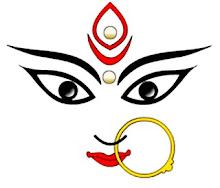
The Bhagawati temple at Kodungallur in Kerala is an ancient one, enshrining Kali - also believed to be a manifestation of Kannagi of the celebrated Tamil epic Silappadikaram. Here is a collection of Shiva temples in Tamilnadu where the Amman (Ambaal or Devi) shrine is of significance.
14 August 2009
Shakthi Sthalams - The Bhagawati Temple at Kodungallur- Kerala
The Bhagawati temple at Kodungallur in Kerala is an ancient one, enshrining Kali - also believed to be a manifestation of Kannagi of the celebrated Tamil epic Silappadikaram. Here is a collection of Shiva temples in Tamilnadu where the Amman (Ambaal or Devi) shrine is of significance.
Shakthi Sthalams - Vaishnao Devi Temple of the Himalayas
Amarnath and Vaishnao Devi are two of the most revered shrines in Jammu and Kashmir. Both these shrines are reached via an arduous pilgrimage trek through the Himalayas.
Vaishnao Devi is located about 60 km North East of Jammu, on the triangular hill Trikoota Bhagwati, in a cave at an altitude of 5300 feet at a distance of 12 km from Katra.
This cave shrines enshrines Vaishnao Devi, a manifestation of the three forms of mother Goddess Shakti - Mahalakshmi, Maha Paarvati and Maha Saraswati.
Shakthi Sthalams - Kalighat Kali Temple, Calcutta
The Kalighat Kali temple in Calcutta in Bengal is one of the most visited temples in Eastern India, and is regarded as one of the Shakti Peethams of the Indian subcontinent.
Shakthi Sthalams - SHANKARI Temple, Sri Lanka
13 August 2009
Shakthi Sthalams - Jwaala Temple in Himachal Pradesh
Shakthi Sthalams - Jogulamba Devi temple at Alampur
Jogulamba Devi temple at Alampur, one of the 18 Sakti peethams in Indian sub-continent, including Sankari Devi temple in Sri Lanka, has been reconstructed after 615 years.
According to historical sources, the temple was razed to the ground during Muslim invasion in 1390 AD. The local people put up a fierce resistance and killed the invaders and moved the main idol to the nearby Balabrahmeswara temple. Since then, the idol had been worshipped in the secluded place in the temple.
Alampur, 20 km from Kurnool, which is known as `Dakshin Kasi' flourished as spiritual and education centre in ancient times.
The Chalukyas of Badami, mainly by the initiative of Pulakesin-II put up a number of temples in and around Alampur in the 7th and 8th centuries. At Alampur alone, Chalukyas built nine temples devoted to Navabrahmeswara and Jogulamba.
Of them, eight magnificent temples of Navabrahmeswara survived but the temple of Tarakabrahma could not be traced.
The Jogulamba temple was reconstructed at the same place where it stood. The temple was rebuilt in the same way it was described in the `Rasaratnakaram' of Nityanatha Sidha of 12th century AD. Sankaracharya was believed to have installed `Sri Chakra' at Jogulamba temple, which is not available now.
Since the Alampur temple complex was declared a heritage site, the supporters of Jogulamba temple had a difficult time to convince the Archaeological Survey of India and the State Government to revive the temple.
Fund mobilisation
The temple was designed to match the Chalukyan architecture so that the new temple would fit into the group of temples.
The Endowments Department, led by the former Commissioner, Ajay Kallam, took initiative to raise funds for reconstruction of the temple. The temples across the country donated money for the temple while Srisailam Devastanam adopted it to ensure uninterrupted rituals.
Giving the reasons for failure to revive the temple in the last 600 years, Sanskrit scholar, historian and epigraphist, Gadiyaram Ramakrishna Sarma, has analysed that political uncertainty prevailed during the medieval age delayed the reconstruction of the temple.
Shakthi Sthalams - Ambaji - Shakti Peeth in Gujarat
Bhadrakali the liberator.The river Saraswati is said to originate at Plaksha Prasaravana in the Shivalik hills of the Himalayas, and disappear into the ground at Vinasana near Kurukshetra. It is said to originate again at Ambaji, and disappear into the Kuthch desert, originate again in the Gir forest in Saurashtra and drain into the sea at Somnath. The Mahabharata, Padma Purana, Saraswati Purana and the Skanda Purana describe these beliefs associated with the river Saraswati.Shakthi Sthalams - Kamakhya Temple- in Assam
SHAKTHI STHALAMS - SAMAYAPURAM MAARIAMMAN TEMPLE
The Maariamman Temple at Samayapuram in the vicinity of Tiruchirappalli is one of the well visited shrines in Tamilnadu, dedicated to Maariamman, a manifestation of the primeval energy Shakti as the mother Goddess.
rs placed image on the ground and paused for rest, and then found themselves to be unable to lift it off the ground. A temple was then established in the vicinity of Tiruchirappalli, which was later expanded by Vijayaranga Chokkanatha Nayak of Madurai of the 18th century.
Samayapuram was a local capital of the Vijayanagar rulers in the vicinity of Tiruchirappalli, and was known as Vikramapuram.
12 August 2009
SHAKTHI STHALAMS - GAYA - MANGALA GOWRI
Significance: This is a shrine dedicated to Shakti or the mother Goddess in the predominantly Vaishnavite pilgrimage center of Gaya. Mangalagowri is worshipped as the Goddess of benevolence. This temple constitutes an Upa-Shakti Pitha - where it is believed that a part of the body of Shakti fell - according to mythology. It is a well visited temple where Shakti is worshipped in the form of a breast symbol, a symbol of nourishment.
SHAKTHI STHALAMS - MOOKAMBIKA ( Kollur)
The Mookambika shrine at Kollur is one of the most revered pilgrimage centers in Karnataka (and in Kerala). It is located at a distance of 147 km from Mangalore. The nearest railhead is Udupi, and it is well connected with tourist centers such as Mangalore and Shimoga in Karnataka and Kannanur in Kerala.
SHAKTHI STHALAMS - KAMAKSHI AMMAN TEMPLE AT MAANGADU (Near Chennai)

SHKATHI STHALAMS - KARUMAARIAMMAN TEMPLE AT TIRUVERKADU
SHAKTHI STHALAMS - CHAMUNDEESWARI HILL TEMPLE, MYSORE
SHAKTHI STHALAMS - BHAGAWATI AMMAN OF CHOTTANIKKARA
SHAKTHI STHALAMS - BHAVANI TEMPLE AT TULJAPUR
SHAKTHI STHALAMS - MAHALAKSHMI TEMPLE OF KOLHAPUR
SHAKTHI STHALAMS - KALIKAMBAL TEMPLE IN CHENNAI
Of the numerous temples that line the southern meteropolis of Chennai, the Kalikambal temple in the heart of old Madras, in George Town stands out for its historic significance and its tradition of festivals, and it attracts thousands of devotees throughout the year. This temple has been visited by the great Maratha ruler Shivaji, and its visibility has grown steadily in the last two decades.
SHAKTI STHALAMS - KANYAKUMARI TEMPLE
11 August 2009
SHAKTHI STHALAMS - KAMAKSHI AMMAN TEMPLE AT KANCHIPURAM
Kamakshi Amman Temple is a famous Hindu temple dedicated to Goddess Kamakshi a divine form of Parvati. It is located in the historic city Kanchipuram, near Chennai, India and is popularly associated with Adi Sankaracharya, one of the greatest Hindu saints. Along with Madurai Meenakshi, Thiruvanaikaval Akilandeswari, Vishalakshi Varanasi, Kamakshi is an important part of worship of Parvati.
It is interesting to note that the main deity is seated in a majestic Padmasana posture, an yogic posture signifying peace and prosperity, instead of the traditional standing pose in most other temples of Parvati. The goddess holds a sugarcane bow and lotus and parrot in the lower two of her arms (Many of the Hindu god forms generally have four arms) and has the two divine instruments Pasa and Angusa in her upper two arms. It is interesting to note that there are no traditional Parvati or Shakthi shrines in the city of Kanchipuram, apart from this temple, which is unusual in a traditional city that has hundreds of traditional temples.
There are various legends attributed to it. One of them according to Kamkshivilasa is that the Goddess had to absorb all the other shakthi forms to give boon to Manmatha (the Hindu god of fertility and love). Another legend attributes it to the Raja Rajeswari pose of the deity that signifies an absolute control over the land under its control, leaving no other forms of Shakthi.
Legend has it that Kamakshi offered worship to a Shivalingam made out of sand, under a mango tree and gained Shiva's hand in marriage.
Kamakshi and Adi Sankaracharya
Adi Sankaracharya is significantly associated in the rich history of the temple. Like many other ancient goddesses, the form of Kamakshi was less benign than the current form. There used to be various forms of animal and human sacrifices in ancient Shakthi temples and it is believed that Adi Sankaracharya led to the more peaceful representation of the goddess by placing a divine Chakra before it. And the goddess agreed to show her benign side in the temple, while the forms of Shakthi outside Kanchipuram still had more angrier forms of Shakthi. There is no verifiable historical proof for this, though it is a part of the local folklore. Symbolic of this, during the festivals when the processional deity is taken for a procession around the temple streets, it takes leave from Sankaracharya, at his shrine in the inner corridor. It is also believed that Sankaracharya defeated Buddhist and other philosophers in this place, sparking a revival for Hinduism.